Posted in Documents

Nuovo approccio 2014: le nuove direttive di prodotto
Le nuove direttive UE "Nuovo Approccio", che sono entrate in vigore ad Aprile 2014, sostituiranno le attuali, le caratteristiche principali:
- Adeguamento al Nuovo Quadro Normativo UE "NQN" Pacchetto merci: Vedi
- Responsabilità ben definite a tutta la catena: Importatore, Distribure, Fabbricante.
Gli operatori economici sono responsabili della conformità dei prodotti, in funzione del ruolo rispettivo che rivestono nella catena di fornitura, al fine di garantire un elevato livello di protezione della salute e sicurezza delle persone, in particolare dei lavoratori e, se del caso, degli animali domestici e dei beni nonché una concorrenza leale sul mercato dell’Unione.
- Tracciabilità
Garantire la tracciabilità di un prodotto attraverso l’intera catena di fornitura aiuta a semplificare la vigilanza del mercato e a migliorarne l’efficienza.
Un sistema efficiente di tracciabilità facilita il compito delle autorità di vigilanza del mercato di rintracciare l’operatore economico che mette a disposizione sul mercato prodotti non conformi.
Nel conservare le informazioni richieste ai sensi delle nuove direttive per l’identificazione di altri operatori economici, questi ultimi non sono tenuti ad aggiornare tali informazioni concernenti gli altri operatori economici che hanno fornito un prodotto o ai quali essi hanno fornito un prodotto.
- Uso ragionevolmente prevedibile
Gli Stati membri devono adottare tutti i provvedimenti opportuni per assicurare che i prodotti disciplinati dalle nuove direttive possano essere immessi sul mercato soltanto se, adeguatamente immagazzinati e usati ai fini cui sono destinati, o in condizioni d’uso ragionevolmente prevedibili, e non devono mettere in pericolo la salute e l’incolumità delle persone.
I prodotti disciplinati dalle nuove direttive devono essere considerati non conformi ai requisiti essenziali di salute e di sicurezza stabiliti soltanto in condizioni d’uso ragionevolmente prevedibili, vale a dire quando tale uso possa derivare da un comportamento umano lecito e facilmente prevedibile.
- Nuova Dichiarazione UE di Conformità (formale)
I fabbricanti devono redigere una dichiarazione di conformità UE che fornisca le informazioni richieste a norma delle direttive sulla conformità di un prodotto alle prescrizioni stabilite e da altri atti pertinenti della normativa di armonizzazione dell’Unione.
- Published: 08 May 2014
- Hits: 10784
Posted in CEM File
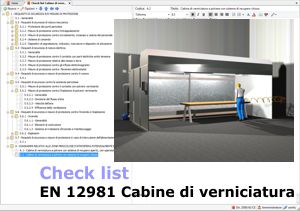
Check list sulla norma armonizzata EN 12981 - Cabine di verniciatura
EN 12981: Testo dei requisiti della Check list e file .cem importabile in CM4 PRO
Rev. 00.2012 - Foto Brianza Aspira
EN 12981 Impianti di verniciatura
Cabine per l’applicazione di prodotti vernicianti in polvere - Requisiti di sicurezza
La norma si applica alle cabine per l’applicazione di prodotti vernicianti in polvere, vale a dire il macchinario e le relative apparecchiature per i processi automatici e/o manuali di applicazione di prodotti vernicianti in polvere.
La norma tratta i pericoli significativi, le situazioni e gli eventi pericolosi relativi alle cabine, quando utilizzate conformemente allo scopo previsto e nel rispetto delle condizioni previste dal fabbricante
- Published: 06 May 2014
- Hits: 13555
Posted in Documents
ebook
Guida Tecnica Direttiva macchine
La Direttiva macchine 2006/42/CE e le principali Norme tecniche
Aggiornamento Maggio 2014 Rev. 3.0
La Direttiva Macchine 2006/42/CE è la Direttiva di prodotto madre per la Sicurezza e Salute di macchine del settore Enterprise and Industry dell'Unione Europea.
Appartiene alla tecnica legislativa del Nuovo Approccio, che rimanda, per il rispetto dei Requisiti Essenziali di Sicurezza e Salute, alle norme tecniche armonizzate EN, secondo il concetto di "Presunzione di Conformità".
La Guida Tecnica Direttiva Macchine, fornisce un quadro generale degli obblighi previsti con interazione pratica con le principali norme tecniche armonizzate EN:
- Direttiva macchine 2006/42/CE
- Norme Armonizzate e Presunzione di Conformità
- Documentazione Tecnica
- Valutazione dei Rischi
- UNI ISO EN 13849-1 Parti dei sistemi di comando legate alla sicurezza
- UNI EN 574 Dispositivi di comando a due mani
- UNI EN 953 Ripari
- UNI EN ISO 14119 Interblocchi (NEW)
- UNI EN 349 Spazi minimi
- UNI EN ISO 13857 Distanze di sicurezza
- UNI EN ISO 13850 Arresto di emergenza
- CEI EN 60204-1 Equipaggiamento elettrico delle macchine
- UNI EN ISO 4413 Sistemi per trasmissioni oleoidrauliche
- UNI EN ISO 4414 Sistemi per trasmissioni pneumatiche
Autore: M. Maccarelli
Categoria: Ingegneria
Pubblicato: 04.05.2014
Dimensioni: 210 pagine
Lingua: Italiano
Editore: Certifico S.r.l.
- Published: 04 May 2014
- Hits: 12737
Posted in CEM File
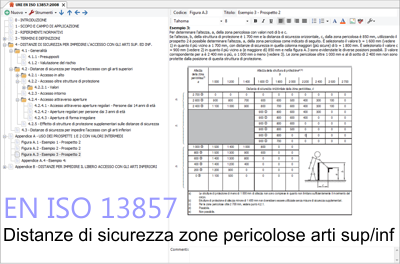
EN ISO 13857:2008 Distanze di sicurezza per impedire il raggiungimento di zone pericolose con gli arti superiori e inferiori
Aggiornata EC1 del 13.05.2010
Estratto Requisiti
La presente norma internazionale stabilisce i valori delle distanze di sicurezza, in ambienti industriali e non industriali, per impedire il raggiungimento di zone pericolose del macchinario. Le distanze di sicurezza sono appropriate per strutture di protezione.
La norma fornisce inoltre informazioni sulle distanze per impedire il libero accesso con gli arti inferiori (vedere punto 4.3).
La presente norma internazionale si riferisce a persone a partire dai 14 anni di età (la statura di un quattordicenne al 5° percentile è di circa 1 400 mm).
Inoltre, solo per gli arti superiori, fornisce informazioni per i bambini oltre i 3 anni di età (la statura di un bambino di 3 anni al 5° percentile è di circa 900 mm) quando deve essere considerato l'accesso attraverso aperture.
EN ISO 13857:2008 Distanze di Sicurezza
Distanze di sicurezza per impedire il raggiungimento di zone pericolose con gli arti superiori e inferiori
Aggiornata con Errata Corrige numero: EC 1-2010 EN ISO 13857:2008
- Published: 09 April 2014
- Hits: 29781
Posted in Documents
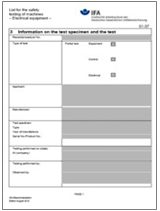
Testing of the electrical equipment of machines
EN 60204-1 (2006), "Safety of machinery - Electrical equipment of machines - General requirements" is a harmonized (Type B) European standard pursuant to the Machinery Directive.
Based upon this standard, the IFA - Institute for Occupational Safety and Health of the DGUV has drawn up a checklist with the aid of which the electrical equipment of machines can be tested in a suitable sequence.
Since each test phase refers to the relevant section of the standard, the checklist is also useful for users who do not use the standard on a daily basis.
- Published: 25 March 2014
- Hits: 19710
Posted in Documents
Guidance on the classification of attachments to construction equipment for the machinery directive 2006/42/EC
The attachments fitted on construction equipment may be considered in the frame of machinery directive 2006/42/EC as part of a machine, interchangeable equipment and Partly Completed Machinery (further called PCM).
This document gives criteria and guidelines to identify the status of the various type of attachment as established by directive 2006/42/EC.
a. Basic attachment or tools
b. Interchangeable equipment
c. Partly Completed Machinery (PCM)
Lifting accessories have also been considered.
This document has been set up to ensure a common understanding between the various parties concerned and a common approach for the manufacturers.
CECE
Committee for European Construction Equipment
- Published: 24 March 2014
- Hits: 12009
Posted in CEM File
Directive 2000/14/EC file CEM
Directive 2000/14/EC of the european parliament and of the council of 8 may 2000 on the approximation of the laws of the member states relating to the noise emission in the environment by equipment for use outdoors.
Annexes
- Published: 19 March 2014
- Hits: 5386
Posted in CEM File
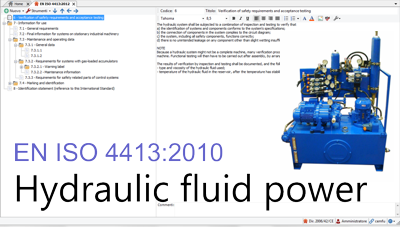
EN ISO 4413:2010
Hydraulic fluid power -- General rules and safety requirements for systems and their components
Abstract
ISO 4413:2010 specifies general rules and safety requirements for hydraulic fluid power systems and components used on machinery as defined by ISO 12100. ISO 4413:2010 deals with all significant hazards associated with hydraulic fluid power systems and specifies the principles to apply in order to avoid those hazards when the systems are put to their intended use.
ISO 4413:2010 applies to the design, construction and modification of systems and their components, also taking into account the following aspects: assembly, installation, adjustment, uninterrupted system operation, ease and economy of maintenance and cleaning, reliable operation in all intended uses, energy efficiency and environment.
(non-official translate p 6,7,8)
- Published: 11 February 2014
- Hits: 22803
Posted in CEM File
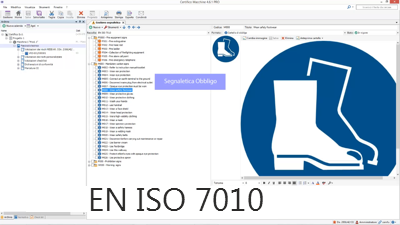
File cem EN ISO 7010
EN ISO 7010 Graphical symbols - Safety colours and safety signs - Registered safety sign
EN ISO 7010:2012 prescribes safety signs for the purposes of accident prevention, fire protection, health hazard information and emergency evacuation.
The shape and colour of each safety sign are according to ISO 3864-1 and the design of the graphical symbols is according to ISO 3864-3.
ISO 7010:2012 is applicable to all locations where safety issues related to people need to be addressed.
However, it is not applicable to the signalling used for guiding rail, road, river, maritime and air traffic and, in general, to those sectors subject to a regulation which may differ with regard to certain points of ISO 7010:2011 and of the ISO 3864 series.
EN ISO 7010:2012 specifies the safety sign originals that may be scaled for reproduction and application purposes.
- Published: 11 February 2014
- Hits: 22532
Posted in Documents
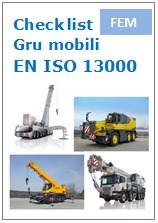
Check list EN ISO 13000 Craines
This guideline is meant to help to easily distinguish between compliant and non-compliant mobile crane.
It describes only those essential criteria which can be checked even without indepth knowledge and technical information.
FEM - Fédération Européenne de la Manutention
- Published: 11 February 2014
- Hits: 10152
Posted in Documents
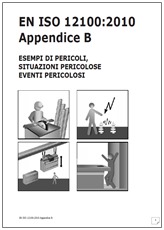
EN ISO 12100 Appendice B
1. ESEMPI DI PERICOLI
2. SITUAZIONI PERICOLOSE
3. EVENTI PERICOLOSI
La appendice fornisce, in prospetti separati, esempi di pericoli, situazioni pericolose ed eventi pericolosi per chiarire questi concetti e per aiutare le persone che svolgono la valutazione del rischio nel processo di identificazione dei pericoli.
Gli elenchi dei pericoli, delle situazioni pericolose e degli eventi pericolosi riportati nella presente appendice non sono esaustivi e non sono presentati in ordine di priorità.
Pertanto, il progettista dovrebbe anche identificare e documentare tutti gli altri pericoli, situazioni pericolose o eventi pericolosi esistenti nella macchina.
- Published: 08 May 2014
- Hits: 13206
Posted in CEM File
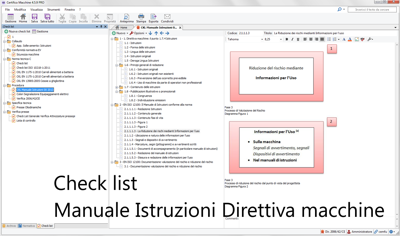
Check list Manuale Istruzioni
Check list Manuale Istruzioni in conformità Direttiva macchine 2006/42/CE Allegato I RESS punto 1.7.4
ed
EN ISO 12100 p. 6.4 Informazioni per l’Uso.
Una Check list coerente con:
1. Direttiva macchine 2006/42/CE
2. Norma tecnica EN ISO 12100
1. Direttiva macchine 2006/42/CE Allegato I RESS 1.7.4
Il punto 1.7.4 dell’Allegato I RESS della Direttiva macchine 2006/42/CE tratta di uno degli obblighi da soddisfare dal fabbricante prima che la macchina sia immessa sul mercato e/o messa in servizio.
Il primo paragrafo del punto 1.7.4 prevede che ogni macchina sia accompagnata dalle istruzioni per l’uso.
Pertanto, le istruzioni devono essere redatte prima che la macchina venga immessa sul mercato e/o messa in servizio e devono accompagnare la macchina fino al momento in cui giunge all'utilizzatore.
Gli importatori o i distributori della macchina devono pertanto accertarsi che le istruzioni siano trasmesse all’utilizzatore.
2. EN ISO 12100 p. 6.4 Informazioni per l’Uso
2.1.1.1.1 La redazione delle informazioni per l’uso è una parte integrante della progettazione di una macchina.
Le informazioni per l’uso consistono in mezzi di comunicazione, come testi, parole, cartelli, segnali, simboli o diagrammi, utilizzati separatamente o in combinazione per trasmettere informazioni all'utilizzatore.
- Published: 06 May 2014
- Hits: 16074
Posted in Harmonized standards Machinery Directive

Directive 2006/42/EC Machinery Harmonised Standards April 2014
Commission communication 2014C 110-02 date 11.04.2014
Commission communication in the framework of the implementation of the Directive 2006/42/EC of the European Parliament and of the Council of 17 May 2006 on machinery, and amending Directive
95/16/EC (recast)
(Publication of titles and references of harmonised standards under Union harmonisation legislation)
View online
Archive Communication Macchinery Directive Harmonized Standards
Attachments:
 2014C 110-02 IT.pdf 2014C 110-02 IT.pdf | [Norme armonizzate Direttiva macchine 04.2014] | [Italiano] | 2489 kB | 7352 Downloads |
| 2014C 110-02 EN.pdf | [Machinery Directive Harmonised Standards 04.2014] | [English] | 2063 kB | 5773 Downloads |
- Published: 11 April 2014
- Hits: 44103
Posted in CEM File
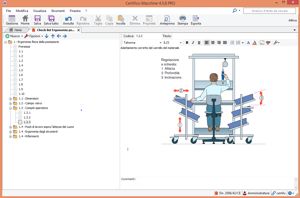
Check list Ergonomia dei posto di lavoro manuali
Direttiva macchine 2006/42/CE
All. I RESS 1.1.6
RESS 1.1.6
Nelle condizioni d'uso previste devono essere ridotti al minimo possibile il disagio, la fatica e le tensioni psichiche e fisiche (stress) dell'operatore, tenuto conto dei principi seguenti dell'ergonomia:
- tener conto della variabilità delle dimensioni fisiche, della forza e della resistenza dell'operatore,
- offrire lo spazio necessario per i movimenti delle parti del corpo dell'operatore,
- evitare un ritmo di lavoro condizionato dalla macchina,
- evitare un controllo che richiede una concentrazione prolungata,
- adattare l'interfaccia uomo/macchina alle caratteristiche prevedibili dell'operatore.
Check list estratta da:
Manuale raccomandazioni ergonomiche per le postazioni di lavoro metalmeccaniche - INAIL 2008
Fridericiana Editrice Universitaria
Immagini tratte da Attanaiese E, Progettare la manutenibilità, Liguori Editore, Napoli, 2008
La check-list dell’ergonomia per i sistemi di lavoro manuali - BOSCH Rexoth
- Published: 08 April 2014
- Hits: 13979
Posted in Documents
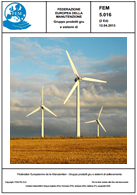
Guideline Safety Issues in Wind Turbine Installation and Transportation
This document serves to inform crane operators, project planners and also crane companies about safety issues during rigging of wind mills, especially about wind influences on a mobile crane on the job site.
The third chapter is an introduction to the basics of wind loads as e.g. covered by the European Standard for mobile cranes, EN13000.
In the following it will be shown how wind loads and finally special load cases, such as when erecting wind-power turbines, can be calculated.
Likewise it will be shown which information is required.
This document does not claim to be complete and is complementary to the operating instructions of the particular crane. As such it does not replace the operating instructions and the load chart book for the crane in question.
It is intended to create more sensitivity for the work with heavy plants by issuing this document.
FEM herewith offers the experience of all manufacturers joined in the association.
FEM
Fédération Européenne de la Manutention
Product Group Cranes and Lifting Equipment
FEM document 5.016 04/2013
- Published: 24 March 2014
- Hits: 10670
Posted in CEM File
Directive 97/23/EC PED file CEM
Directive 97/23/EC of the European parliament and of the council of 29 may 1997 on the approximation of the laws of the member states concerning pressure equipment.
Annex I
- Published: 20 March 2014
- Hits: 4390
Posted in CEM File
Directive 94/9/EC file CEM Annex II
Directive 94/9/EC of the European Parliament and the Council of 23 March 1994 on the approximation of the laws of the Member States concerning equipment and protective systems intended for use in potentially explosive atmospheres
Essential Health and Safety Requirements relating to the design and construction of equipment and protective systems intended for use in potentially explosive atmospheres.
- Published: 18 March 2014
- Hits: 3980
Posted in CEM File
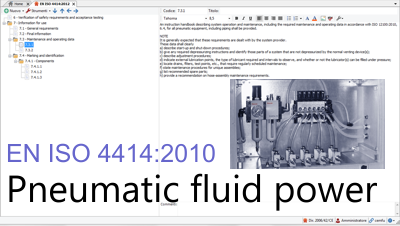
EN ISO 4414:2010
Pneumatic fluid power -- General rules and safety requirements for systems and their components
Abstract
ISO 4414:2010 specifies general rules and safety requirements for pneumatic fluid power systems and components used on machinery as defined by ISO 12100. ISO 4414:2010 deals with all significant hazards associated with pneumatic fluid power systems and specifies principles to apply in order to avoid those hazards when the systems are put to their intended use.
ISO 4414:2010 applies to the design, construction and modification of systems and their components, also taking into account the following aspects: assembly, installation, adjustment, uninterrupted system operation, ease and economy of maintenance and cleaning, reliable operation in all intended uses, energy efficiency and environment.
ISO 4414:2010 does not apply to air compressors and the systems associated with air distribution as typically installed in a factory, including gas bottles and receivers.
(non-official translate p. 6,7,8)
- Published: 11 February 2014
- Hits: 20801
Posted in Documents
ISO/TR 14121-2:2012
Safety of machinery
Risk assessment
Part 2: Practical guidance and examples of methods
ISO/TR 14121-2:2012
Extract 6.5 Hybrid Tool - License Certifico S.r.l.
- Published: 11 February 2014
- Hits: 26804
Posted in Documents
Machinery Directive Annex 1.1.6 EHSR Ergonomics
Guidance on the application of the essential health and safety requirements on ergonomics set out in section 1.1.6 of Annex I to the Machinery Directive 2006/42/EC
The guidance provided in the following documents is complementary to the Guide to application of the Machinery Directive 2006/42/EC, in particular, to §181 of the Guide.
The family of harmonised standards developed by CEN TC 122 - Ergonomics to support the Machinery Directive’s application.
Relationship between the ergonomic factors mentioned in section 1.16 of Annex I and the family of standards developed by CEN TC 122 - Ergonomics.
European Commission - 2012
- Published: 11 February 2014
- Hits: 10249